Austria
 Belgium
 Bulgaria
 Croatia
 Czech Republic
 Denmark
 Estonia
 Finland
 France
 Germany
 Greece
 Hungary
 Ireland
 Italy
 Latvia
 Lithuania
 Luxembourg
 Netherlands
 Poland
 Portugal
 Romania
 Slovakia
 Slovenia
 Spain
 Sweden
Commercial Immersion Blenders: How to Choose the Right Machine
2026. 11. 27.
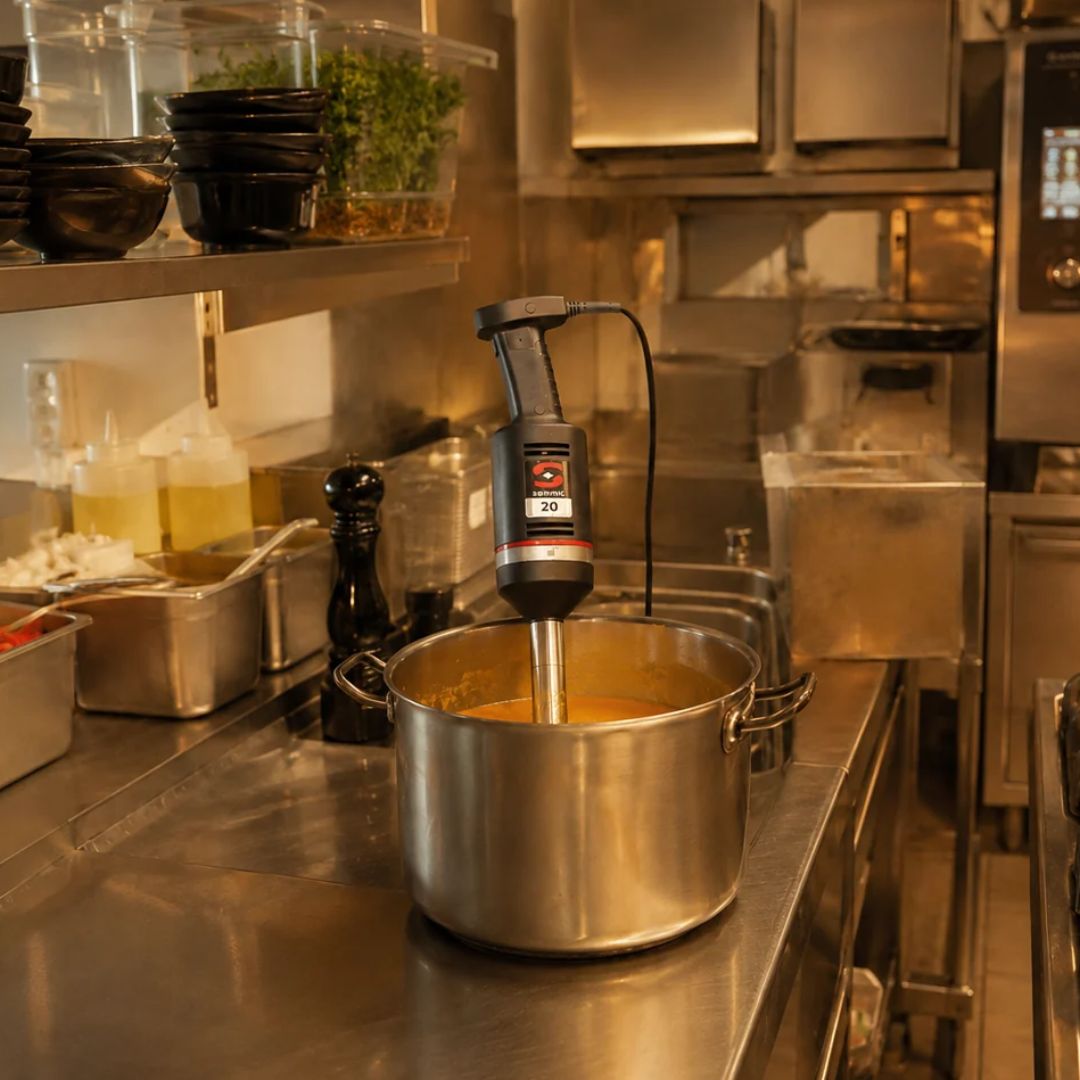
With a really good cream soup, texture matters just as much as flavour. The same goes for silky sauces, vegetable purées and all kinds of creams. In a busy kitchen, though, it makes a big difference how much time and effort goes into preparing them. This is where the commercial immersion blender comes in, proving its worth in everything from small eateries to large-scale kitchens. We looked at where it came from, which types are available and what to consider before buying.
The history of the immersion blender: from a Swiss idea to professional kitchens
An important milestone in the history of the hand-held immersion blender is the idea patented by Swiss inventor Roger Perrinjaquet in 1950. His appliance was named bamix, derived from the French words battre (to beat) and mixer (to mix). The concept is still the same today: a motor-driven rotating blade is immersed directly in the pot to process the ingredients.
As professional kitchen machines evolved, hand-held blenders also became more powerful, more durable and more versatile. The French company Robot-Coupe has been developing food preparation machines since 1961 and introduced its immersion blenders with a detachable shaft in 1996. Later models added variable speed, interchangeable working heads and designs adapted to larger pots and intensive use. Today, the ranges of the Spanish SAMMIC and other professional manufacturers include solutions for small quantities as well as for kettles of several hundred litres.
What can a commercial immersion blender be used for?
The biggest advantage of a hand-held immersion blender is that food can be processed directly in the pot it was cooked in. There is no need to transfer hot soups or sauces into a separate blender, which makes the workflow simpler and faster and reduces the number of dishes to wash.
The most common applications:
- Cream soups, vegetable stews: fast, even blending of larger batches.
- Vegetable and potato purées: side dishes, baby food and dishes with a special texture.
- Sauces, gravies and creams: achieving a homogeneous texture and, with proper mixing, making emulsions.
- Cold preparations: dressings, vegetable creams and some smoothies.
- Pastry preparation: with a suitable whisk attachment, whipping cream, egg whites and light creams.
It does matter, however, whether you need to blend a few litres of soup a day or the contents of an entire catering kettle. Besides quantity, the density of the ingredients, the desired result and how often you use the machine all determine what kind of appliance you need.
Fixed or variable speed?
One of the most important differences between immersion blenders is whether the speed can be adjusted. It may seem like a minor detail at first, but in practice it matters whether the machine always runs at the same speed or whether its operation can be adapted to the task at hand.
Fixed-speed immersion blenders
Fixed-speed models run at a predetermined speed. They are easy to operate and especially practical when the kitchen regularly has to carry out the same tasks in large quantities.
In the professional range, 12,000 rpm is a common example for fixed-speed machines. This speed works efficiently for processing soups, stews, vegetable purées and sauces. However, actual performance is not determined by speed alone: the power of the motor, the design of the blade, the size of the pot and the consistency of the ingredients all matter as well.
Variable speed
The situation is different if the immersion blender has to handle a variety of tasks every day. With an adjustable-speed appliance, you can match the working pace to the ingredient and the desired texture. At a lower speed you can start blending more gently, which can be especially useful for reducing splashing. And when faster, more intensive blending is needed, you can switch to a higher speed.
Depending on the type, the models in the GAMMO range can operate, for example, within 1,500–15,000, 4,000–16,000 or 8,000–18,000 rpm. These are not general standard values but characteristics of specific machines.
Variable speed is especially useful with ingredients of different density, smaller batches, finer sauces and kitchens where the immersion blender performs many different tasks.
Which brand and size should you choose?
The right machine is not necessarily the most powerful or the largest one. The goal is for power, ease of handling and the shaft length needed for the job to be in line with the needs of your kitchen.
- HORECATECH – a practical solution for smaller kitchens. It can be a good choice for small bistros, snack bars, fast-food outlets and kitchens working with moderate quantities. Its compact, lightweight design can also be an advantage for household tasks, especially where professional usability is an important consideration.
- MAXIMA – a versatile partner in everyday large-kitchen work. Variable-speed models available with several shaft options can be a suitable solution in mid-sized restaurants, care homes, and industrial and public catering kitchens. Versions with a longer shaft can also be used in larger pots and with significant quantities.
- SAMMIC – for professional use, across a wide capacity range. Several versions are available, from compact models to machines designed for larger kettles. With the right model, a food truck or a restaurant can find the tool it needs just as a central kitchen or a large-scale food production unit can. The brand's range includes fixed- and variable-speed versions as well as versions that can also be used for whisking.
When choosing, the shaft length and the actual immersion depth are especially important. A shaft that is too short will not properly reach the ingredients at the bottom of a deep kettle, while a machine that is too long and heavy can needlessly strain the operator when used in smaller pots. It is worth considering the motor power, the weight of the machine, the planned continuous use and the quantity to be processed together.
Interchangeable shafts and whisk attachments
For some models, the blending shaft can also be purchased separately. This can be a practical solution if you need a spare shaft or if the kitchen would like to use working heads of different lengths for different pot sizes. However, interchangeability always depends on the compatibility of the specific model.
A whisk attachment, on the other hand, can only be used with variable-speed motor units designed for it. Whisking requires a much lower speed than blending: for some of SAMMIC's combination models, for example, the speed range of the whisk attachment is 200–1,500 rpm, while that of the blending shaft is 1,500–12,000 rpm. The right speed and the special drive ensure that whisking is controlled and adapted to the ingredient.
When buying an accessory, it is therefore not enough to know the brand: you also need to check that it fits the exact model.
Find the immersion blender that fits your kitchen!
When choosing an appliance, the most powerful model is not necessarily the best decision. It is far more important that the machine fits your daily tasks, the quantity of food you prepare and the size of your pots. For a smaller restaurant, a compact, fixed-speed appliance may be enough, while an establishment with a varied menu can benefit from adjustable speed and interchangeable working heads. In large-scale kitchens, the right shaft length, load capacity and a design built for intensive use come to the fore.
Browse the GAMMO range of commercial immersion blenders, and choose a model that suits your usage volume, the speed you need and the size of your pots. If you are unsure about choosing the right power, shaft length or accessory, it is worth starting from the specific task and adapting the machine to it.